

Contents
Start with the crew
Choose the boat around the people who will live aboard, not around the number in the brochure. Write down who cooks, who sleeps lightly, who gets seasick and who will handle lines. For July and August, useful shade, easy boarding and a calm cockpit often matter more than an extra knot of speed. A yacht that keeps daily decisions simple leaves more energy for the islands.
Catamaran or monohull: what changes on a week
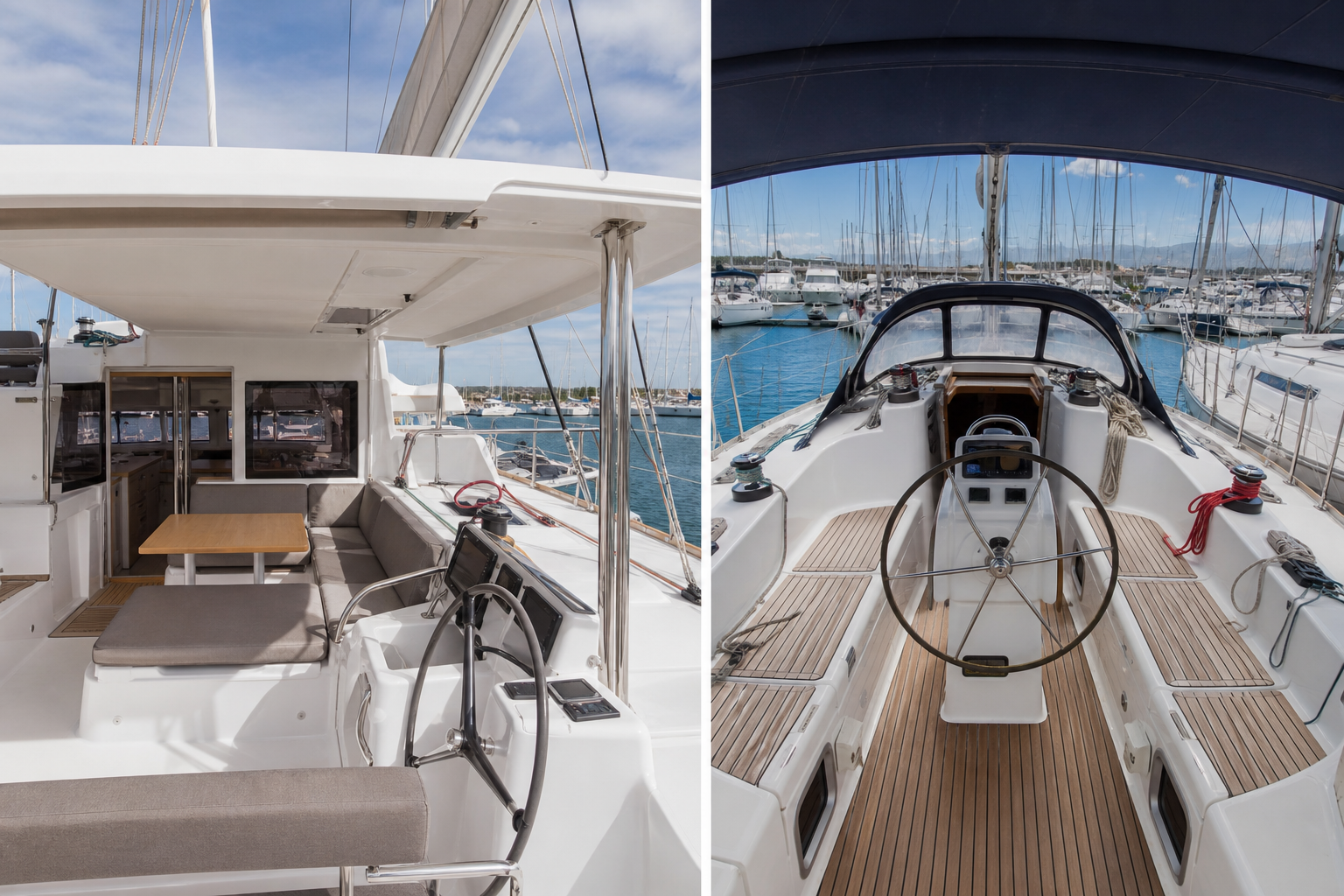
A catamaran gives two separate hulls, a level saloon and generous deck circulation. That helps a family divide bedtime from dinner and lets a guest step ashore without climbing over the cockpit. At anchor, the platform usually rolls less, although a wide boat can yaw differently in a crosswind. A monohull has a narrower beam, a familiar heel under sail and often a more compact price. Its saloon may feel cosier, and its single hull can be easier to place in a tight berth. Decide which sensation your group will enjoy every afternoon, not which specification looks impressive.
Do not compare only the number of cabins. Check berth configuration, mattress sizes, ventilation, heads, refrigerator capacity and where wet towels will dry. On a catamaran, engines and cabins are separated across hulls; that is excellent for privacy but means a child may be farther from the skipper at night. On a monohull, the central saloon is a natural meeting point, but movement below deck can be livelier in a swell. Ask for the actual layout plan and photograph of the same boat before you sign.
Five technical checks that prevent an expensive mismatch
Beam is the first overlooked number. A broad catamaran may be wonderfully social, yet the width determines which marina berths are available and whether the price changes. Ask for the berth width, fenders supplied and shore-power location. Draft is the second number: a shallow boat can reach more coves, but only if the charted depth, swing room and protected-area rules permit it. Treat “goes anywhere” as a sales phrase until the operator confirms a real anchorage.
Then inspect propulsion and manoeuvring. Two engines can make a catamaran precise in a marina, but the controls feel different from a single propeller. A bow thruster helps on a monohull, yet it does not replace a briefing on prop walk. Check whether the yacht has electric winches, a working anchor windlass, cockpit lighting and a tender large enough for your crew. Finally, ask for recent maintenance notes or engine hours; reliability buys more holiday time than an extra gadget.
Price the week, not the headline
Build a one-page budget before comparing boats. Separate the weekly charter fee from the transit log, final cleaning, tourist tax, fuel, water, marina nights, buoy reservations, provisioning, skipper and security deposit. Ask which costs are fixed and which depend on consumption. A cheaper monohull may need more marina nights if the crew wants a stable berth; a catamaran may reduce shore accommodation but attract a higher berth fee because of its beam. The meaningful comparison is the expected total for your route.
Payment terms deserve the same attention as the boat. Confirm when the balance is due, what happens if the named yacht is substituted, how the deposit is authorised and which damage is excluded from a waiver. Keep a written list of promised equipment: child-size lifejackets, linen, paddleboard, generator or air-conditioning. If an item affects safety or sleep, put it in the contract or booking confirmation. A clear paper trail makes a last-minute discussion at the dock much shorter.
Match the yacht to Palma, Menorca or Ibiza
Palma de Mallorca suits a group arriving on different flights and anyone who values a deep service network. The airport transfer is straightforward, provisioning is flexible and a first night in the bay can stay short. Menorca’s Mahón has a naturally sheltered harbour and a quieter feel; it rewards a boat that can enjoy longer anchorages without needing a busy marina every evening. Ibiza and Formentera create attractive short hops, but peak-season moorings and environmental restrictions make a careful reservation plan essential.
The island name is not enough to price or plan the charter. Ask for the exact marina, pontoon, check-in window, fuel berth and return time. A broad catamaran may be ideal in a bay yet require an earlier berth reservation in Palma. A monohull may fit more marinas but feel less stable for guests at anchor. If the operator gives two boat options, ask them to map each one to the intended first-night stop and the fallback if the wind turns north.
Use a weather margin as a yacht-selection criterion
The Balearics can combine a pleasant summer sea-breeze with stronger northerly Tramuntana episodes. This matters because the most spacious boat is not automatically the easiest boat to turn around in a fresh wind. Ask how the charter company handles a late handover, a forecast that closes an anchorage or a need to return a day early. Select a yacht with equipment and an experienced skipper that give the crew options, rather than one that only looks good on a calm-weather itinerary.
Agree on the no-go rule before leaving the dock: daylight arrival only, protected overnight when the wind exceeds your crew’s comfort, and a mandatory call to the base if the forecast changes. A boat with air-conditioning or a generator may improve comfort, but it does not replace an early departure, two anchorage options and a return buffer. In a first charter, flexibility is a real feature you are buying.
Final choice before payment
- The offer names the actual yacht, year, beam, draft and berth conditions.
- The layout works for your sleeping, cooking and child-safety routine.
- Mandatory and variable costs are separated and the deposit terms are clear.
- The operator confirms equipment, exact marina and a weather fallback in writing.
- Your licence, skipper plan and return-day buffer match the selected boat.
Sources and verification date
Use Ports de les Illes Balears for current port and marina information, then confirm the berth and operational details with the charter company. This guide is planning information, not a substitute for a licence review, contract or official forecast. Sources and practical checks were reviewed on 28 August 2026.
Sources