

Contents
The short answer: match the hull to the holiday
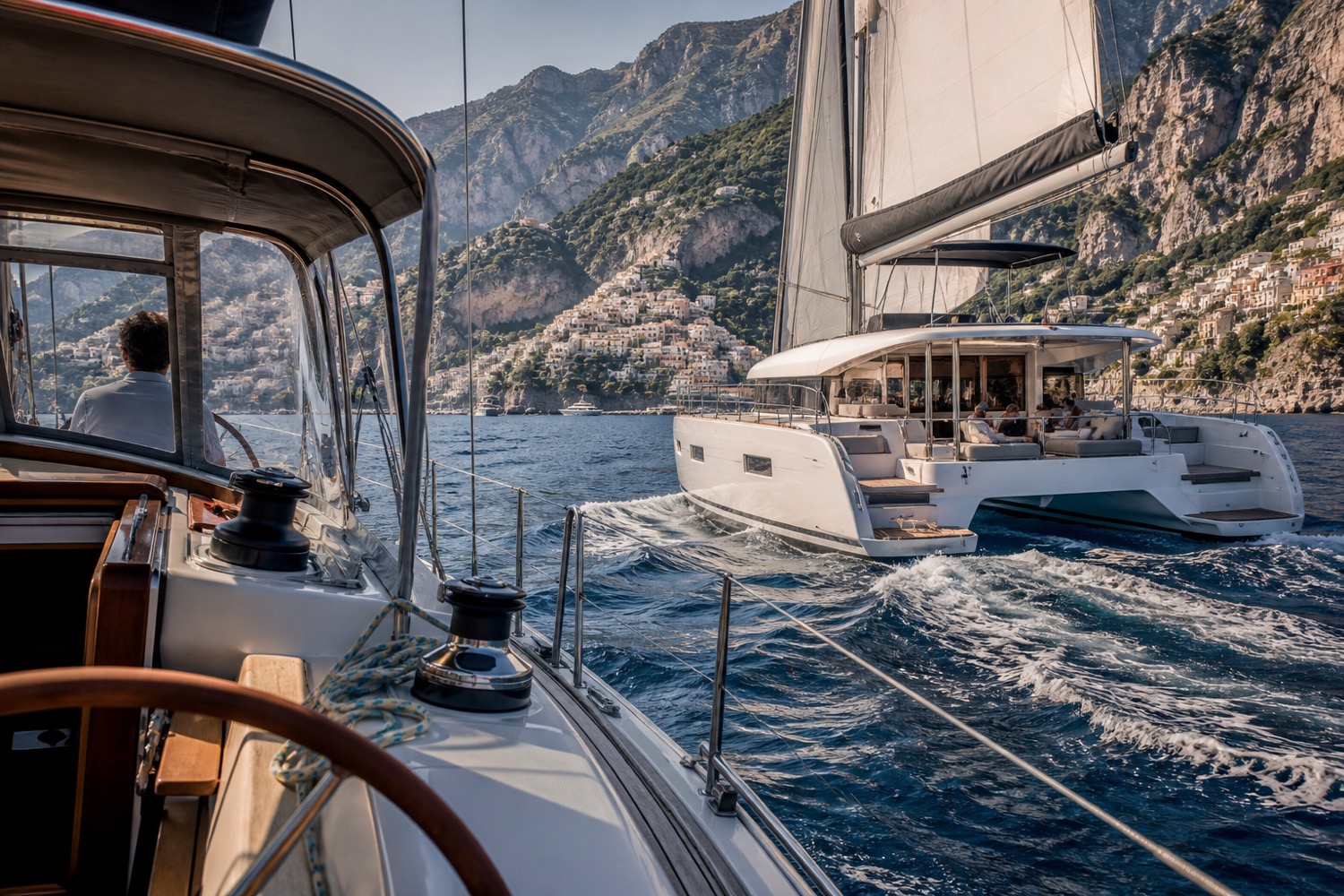
Start with the trip, not the boat brochure. A catamaran gives a wide cockpit, level living areas and shallow draft; that makes swim stops, family routines and two-couple privacy easier. A monohull rewards guests who want heel, quieter sailing and a more compact boat that often fits a wider range of berths.
Neither hull is automatically cheaper. Compare the weekly charter, end-cleaning, outboard, linen, transit log, fuel, marina nights and security deposit as one package. A lower base price can disappear if a catamaran is charged at a higher berth rate or if the crew needs extra transfers.
Space, stability and everyday comfort
The main catamaran advantage is usable volume rather than headline length. Two hulls create separate cabins, larger saloons and a broad aft cockpit, so an eight-person group can spread out without turning every meal into a queue. The level floor is also friendlier for toddlers and guests who dislike heel.
A monohull feels more intimate. The central saloon and single hull keep the group together, while the deeper underwater profile softens short chop once the boat is moving. Expect more heel in a fresh breeze, narrower companionways and less separation between cabins.
For a first Italian charter, be explicit about sleeping fairness: count double berths, convertible saloon berths, en-suite heads and the cabin nearest the companionway. A nominal eight berths can feel very different on a 46-foot catamaran and a 46-foot monohull.
Sailing feel, draft and handling
A monohull gives the clearest feedback from the wind: heel, helm pressure and a lively tack. It is the better fit for guests who plan to sail rather than motor between anchorages. Ask for reefing controls, sail area and a realistic upwind plan, not just the model name.
A catamaran stays flatter and often accelerates quickly in light air, but its windage is higher. The skipper needs room to turn in a marina and must manage two engines, a wider beam and more exposed sterns. In strong crosswinds, a bow thruster or reliable engine controls can matter more than an extra cabin.
Draft changes the route. A catamaran with around 1.2–1.4 m draft can reach shallower bays; many monohulls draw roughly 1.9–2.3 m. Confirm the exact boat, because a single model may have several keel options.
Choose the Italian base around the hull
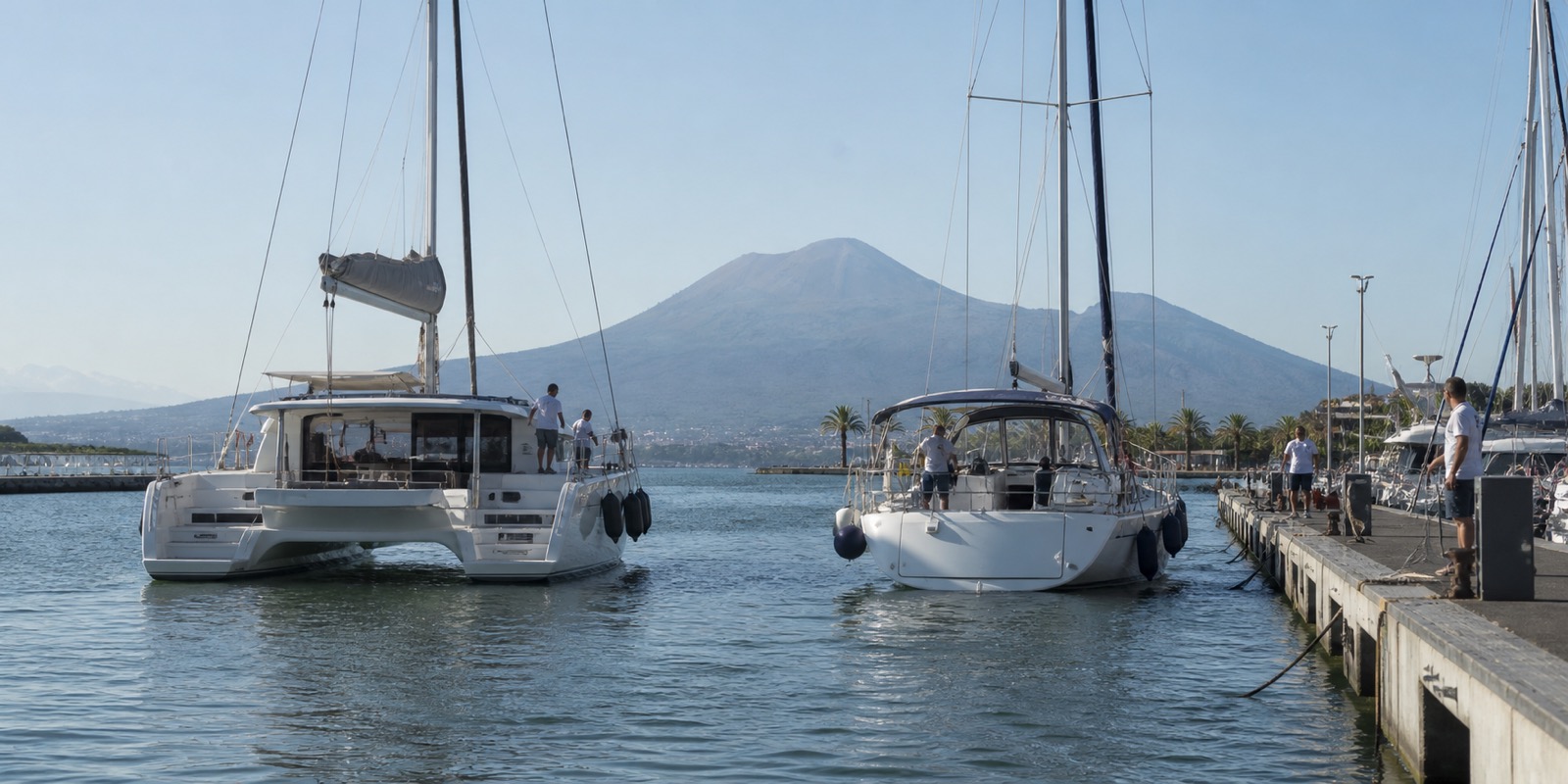
From Marina di Stabia, the Gulf of Naples, Sorrento and the Amalfi Coast are close together. The marina lists 789 berths, depths up to 6.5 m and fingers for boats up to 18 m, with a 3 km quay for larger yachts. That infrastructure suits either hull, but the catamaran’s beam should be confirmed before arrival.
Portisco is the practical gateway to Costa Smeralda: Sardegna Turismo places it close to Olbia airport and port, with Marina di Portisco as the launch point for the north-east coast. It is a strong catamaran choice when bays, beach landings and a short airport transfer matter more than long sailing legs.
Capo d’Orlando is a useful Aeolian base. Its marina lists 553 berths, boats up to 50 m and the islands about 14 nautical miles away. Its published rate card explicitly prices catamarans at twice the monohull transit rate, a reminder to compare berth costs before choosing the wider boat.
Budget and booking checks
Use a four-line comparison: charter fee, mandatory extras, operating costs and risk buffer. Catamarans can cost more at the marina and may consume more fuel under engine, while monohulls can add comfort costs when a group needs a larger model to get the same cabin privacy.
Ask the operator to confirm beam, draft, air-conditioning hours, generator policy, dinghy size, water capacity and the deposit. Request the exact marina tariff for your dates at Stabia, Portisco or Capo d’Orlando rather than relying on a generic ‘berth included’ note.
Weather is part of value. If the forecast turns windy, a catamaran gives a calmer platform but needs careful marina manoeuvring; a monohull may sail more comfortably offshore but heel more at anchor. Build one sheltered alternative into the route.
A decision matrix that works
Choose a catamaran when your non-negotiables are a flat cockpit, separate cabins, shallow coves, an easy swim platform and a group that may not love sailing motion. Choose a monohull when the sailing itself is the attraction, the group is happy to share a tighter social space and the route includes longer windward legs.
If the scores are close, let the base decide: beam-sensitive berths and crowded marinas favour a narrower monohull; shallow anchorages and beach-heavy plans favour a catamaran. For a mixed group, keep the boat comfortable and use the skipper to protect the sailing experience.
The best booking brief names the people, route, draft limit, preferred cabins, sailing ambition and all-in budget. Once those are written down, the right hull usually becomes obvious.
Before you pay the deposit
- Confirm exact length, beam, draft and keel or rudder configuration.
- Count real double cabins and heads; do not rely only on the berth number.
- Request the full mandatory-extras list and a current marina tariff.
- Check dinghy, outboard, water capacity, solar and generator policy.
- Agree who makes the weather call and how route changes are handled.
- Ask for a sheltered alternative for the first and last night.
- Put deposit, cancellation dates and damage procedures in writing.
Sources