

Contents
Short answer
For a first one-week charter in France, Antibes and Port Vauban are a practical starting point. A realistic loop can include Cannes and the Lérins Islands, Saint-Tropez, Porquerolles and the Hyères coast before returning to Antibes. The route is designed for daily passages of roughly 10–30 nautical miles, but the order must follow the forecast and confirmed berths.
Day-by-day route
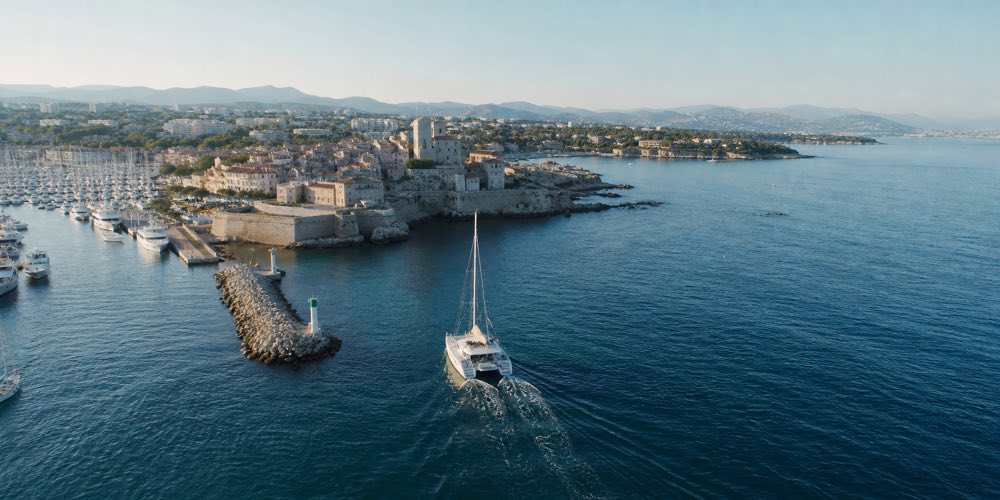
Day 1 — Antibes: complete the handover, test the engine, anchor, VHF, safety equipment and shore power. Port Vauban lists about 1,500 berths, vessels up to 150 metres and VHF channel 9. Keep the first evening local; a delayed check-in should not force a night passage.
Day 2 — Cannes and the Lérins Islands: make a short passage and use the islands for swimming and sail practice. Keep Cannes as a practical overnight alternative if the wind builds. Check the local anchoring and landing rules before sending the tender ashore.
Day 3 — Saint-Tropez: in settled weather, make the longer coastal leg to Saint-Tropez. The official port lists 729 berths, VHF 9, fuel and a technical area, with different limits by basin. Reserve ahead, especially in high season and around Les Voiles de Saint-Tropez. If no berth is confirmed, use a safer alternative rather than relying on an unplanned anchorage.
Day 4 — Saint-Tropez to Porquerolles: leave early and keep fuel and time in reserve. Porquerolles is inside the Port-Cros National Park, where movement, speed and mooring are regulated. Download the current park map, use only permitted areas or authorised moorings and never anchor on seagrass. If the island is full or the sea state changes, divert to Hyères.
Day 5 — Porquerolles and Hyères: keep the day flexible. Explore only if the forecast is stable; otherwise choose a sheltered mainland harbour. The park rules cover anchoring, speed, water toys, diving and wastewater, so the crew should know the restrictions before arrival.
Day 6 — Hyères back towards the Riviera: return along the coast with one planned stop near Cavalaire or Saint-Raphaël. Avoid stacking several mandatory ports into one day. A tired crew and a late final passage create more risk than skipping one destination.
Day 7 — Antibes: return early enough for fuel, cleaning and the final inspection. Keep the last night near the base if the operator requires an early handover.
Two weather scenarios
Stable-weather plan: Antibes → Cannes/Lérins → Saint-Tropez → Porquerolles → Hyères → Cavalaire or Saint-Raphaël → Antibes. Put the longest leg on the calmest day.
Wind-and-sea-state plan: Antibes → Cannes → Juan-les-Pins or Cap d’Antibes → Lérins when conditions allow → Antibes. If easterly wind increases, do not force the Saint-Tropez or Porquerolles leg; if westerly wind builds, avoid making Saint-Tropez the fixed overnight target. Météo-France’s coastal marine forecast for Saint-Raphaël–Menton should be checked with the operator’s briefing before each long passage.
Forecast
Use Météo-France’s coastal marine forecast for Saint-Raphaël–Menton together with the operator briefing before each long passage. Check wind direction and gusts, wave height, thunderstorms and visibility. Sources and verification date: Port Vauban Antibes, Port de Saint-Tropez, Port-Cros National Park and Météo-France Marine. Checked 25 August 2026.
FAQ
Can I do it without a skipper? Only with an accepted licence, VHF qualification and relevant coastal experience.
Should Saint-Tropez be booked? Yes, especially in high season and for boats above 18 metres.
Can I anchor anywhere at Porquerolles? No. Use the current national-park regulation map and authorised areas.
What if the islands are closed by weather? Stay on the Antibes–Cannes–Lérins section and keep passages short.
Sources