

Contents
The useful difference is how the group lives
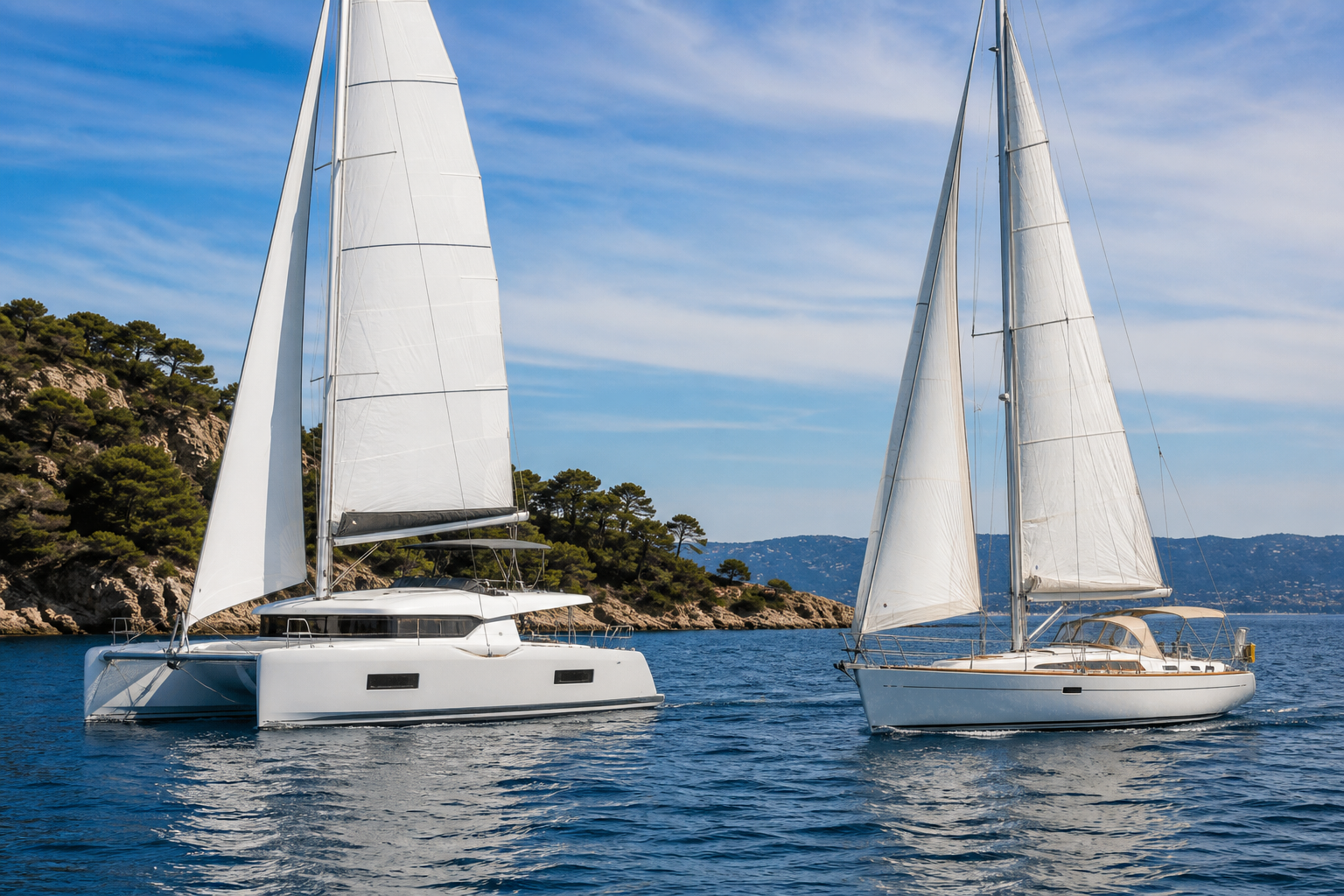
A catamaran spreads daily life across a level saloon, cockpit and two hulls. Friends can talk in the shade, swim from a broad stern and still keep a quiet cabin for a nap. A monohull concentrates the group in a narrower space and adds the familiar heel and rhythm of sailing. That can be exactly what a sailing-focused crew wants. Start with the hours between breakfast and dinner: where will people sit, dry towels, charge devices and retreat when the wind rises?
Do not read “more cabins” as “more privacy” without checking the layout. On a catamaran, cabins may be far apart and share access through an outdoor cockpit. On a monohull, the central saloon is closer to everyone but movement can feel livelier in a swell. Ask for actual mattress dimensions, head count, ventilation, shade and the location of the skipper’s berth. The best boat is the one whose compromises the group understands before payment.
Sailing feel versus easy manoeuvring
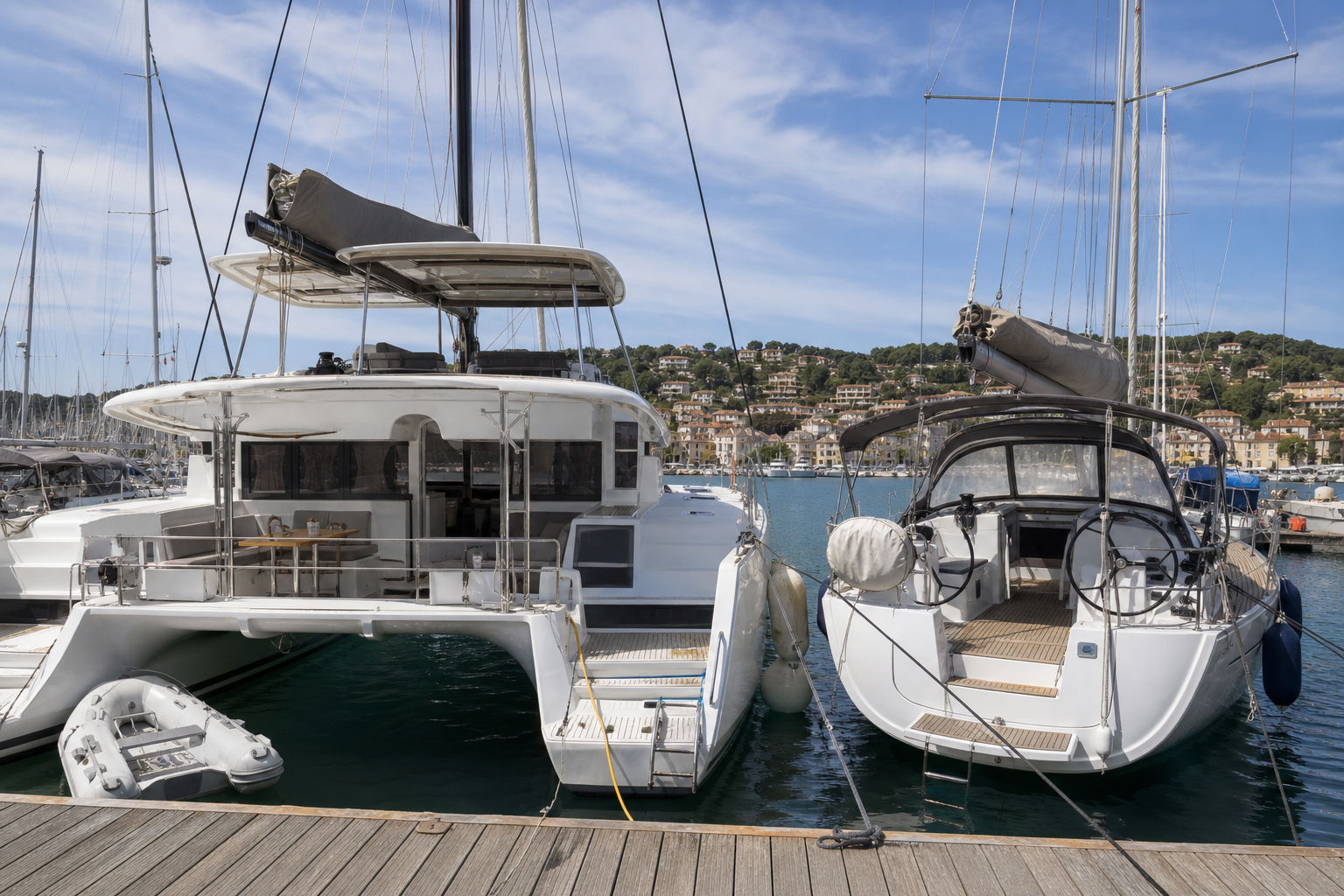
A monohull usually gives the clearest feedback under sail: heel, trim and apparent wind are part of the experience. It also has a narrower beam, which can simplify some marina berths. A catamaran stays level for guests and often has two engines, giving precise low-speed control when the skipper is comfortable with the controls. Its width can make berth choice more limited and may change the marina price. Neither boat is automatically easier; ask for a hands-on briefing and a realistic first-day manoeuvre.
Check the equipment that reduces workload: bow thruster, electric winches, anchor windlass, cockpit lighting, chart plotter and a tender sized for the crew. These features matter when a late arrival, a crosswind or a tired guest makes a manoeuvre less tidy. Treat them as support, not permission to ignore the forecast. A local skipper can show how the selected boat reacts before the full group boards.
Hyères, Porquerolles and the berth question
From Hyères, both types can reach Porquerolles and Port-Cros in short legs, but the overnight decision changes the comparison. A broad catamaran may be excellent at anchor yet need an earlier reservation in a busy port. A monohull may fit more berths and feel efficient under sail, but the group may prefer a marina after a windy day. Ask the operator for the exact berth width, depth, mooring arrangement, fuel point and a mainland fallback before you compare headline rates.
The islands also add rules. Check the current Parc national de Port-Cros guidance for anchoring, landing, swimming and fires, and do not assume that a photograph-worthy cove is available for overnight use. The boat type should support the legal route you can actually sail. If a protected area closes, a shorter mainland passage is a successful decision, not a downgrade.
Compare the complete cost
Build the same budget for both boats: charter fee, transit log, cleaning, fuel, water, marina and buoy nights, skipper, provisioning, transfers and security deposit. Beam can change marina fees; a cheaper monohull is not cheaper if the group adds shore accommodation or extra nights ashore. A catamaran may cost more to berth but reduce the need for separate rooms. Compare the expected total for your intended week and guest count, not the lowest weekly rate.
Put substitution, cancellation and damage-waiver terms next to the price. Ask which equipment is included, who pays if a promised item is unavailable and when the deposit is released. The written offer should name the actual model, year, beam, draft and base. Without that information, a comparison is only a category debate.
Use the Mistral margin as a tie-breaker
The French Mediterranean can deliver a pleasant summer breeze and a stronger Mistral episode in the same week. Decide the no-go rule before casting off: daylight arrival, protected overnight and a maximum wind or sea state that the least-experienced guest accepts. A catamaran’s stable platform can help guests at anchor, while a monohull’s narrower profile may suit a different berth or sailing plan. Neither shape overrides a bad forecast.
Ask the base how it handles an exposed anchorage, a delayed handover or a required early return. Select the boat and skipper combination that leaves two realistic options each night. Flexibility is a feature: it lets the group enjoy Porquerolles or Port-Cros when conditions fit and stay near Hyères when they do not.
Decision checklist
- The actual yacht, layout, beam and draft match the crew.
- The berth width, depth, fuel plan and marina cost are confirmed.
- The complete budget includes fixed and consumption-based costs.
- The route has a protected overnight and Mistral fallback every day.
- The skipper demonstrates the selected boat before the full crew boards.
A decision table for your crew
For couples or a small sailing-minded crew, a monohull can keep the budget focused on sailing time and a compact berth. For two families, a catamaran usually pays back in separate sleeping zones, a level cockpit and easier movement for children. If one guest is prone to seasickness, test the motion at anchor and under way rather than relying on a brochure. If the group expects restaurant evenings, check the route from the chosen berth: a wide boat may be comfortable at sea but less convenient in a tight old-port marina. Write the priority in one sentence before requesting offers.
A simple scoring sheet prevents a persuasive sales call from deciding for you. Give each boat a score from one to five for sleep privacy, cockpit shade, sailing performance, marina access, draft, energy use and total cost. Multiply the two factors that matter most to your group by two. Then ask the base to explain any missing specification in writing. This approach keeps the comparison useful even when the exact model changes.
Sources and verification date
Check Météo-France for the official forecast and the Parc national de Port-Cros for current visitor and anchoring rules. Confirm boat, berth and contract details with the charter base. Sources and practical checks were reviewed on 28 August 2026.
Sources