

Contents
The short answer
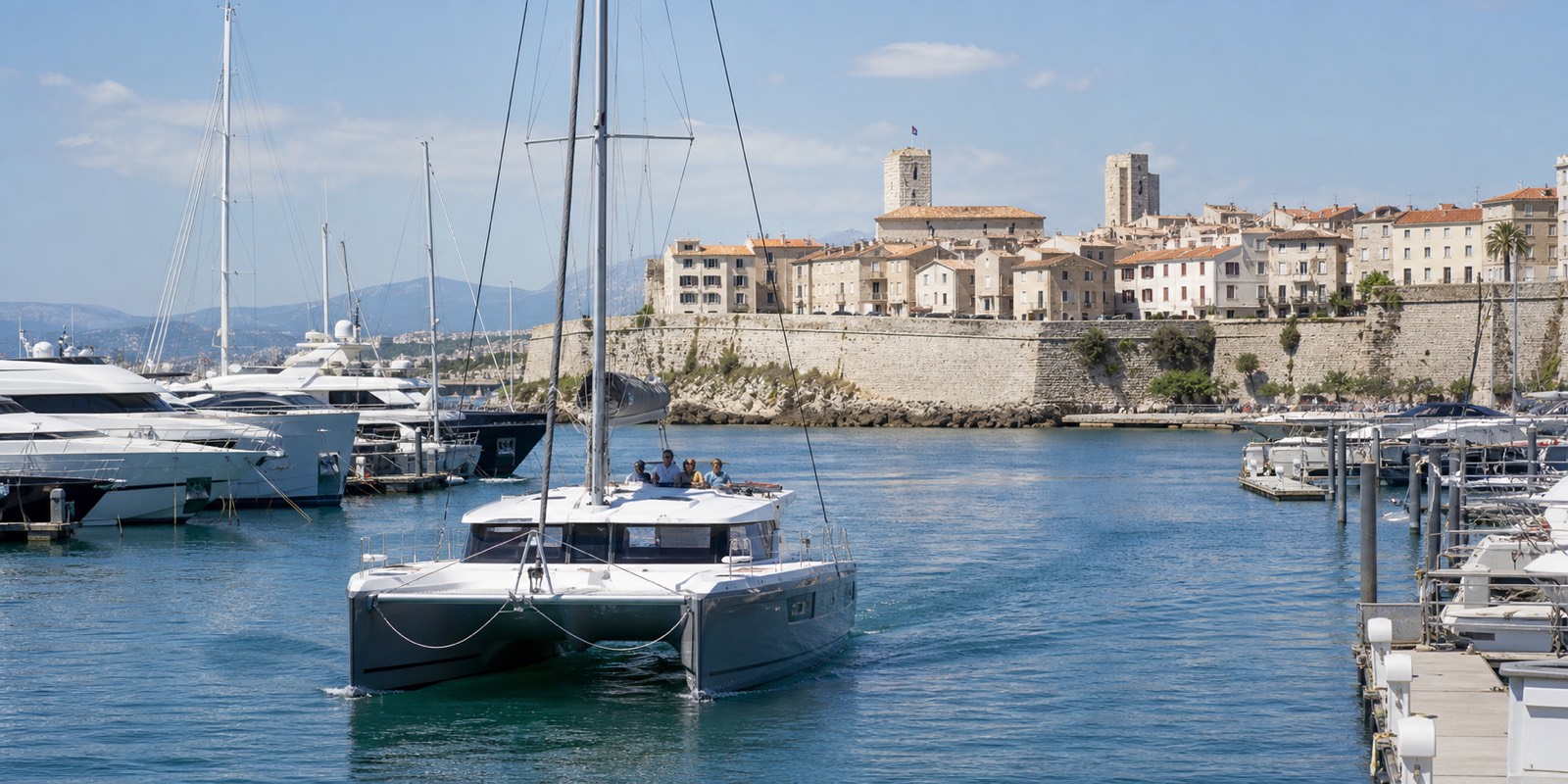
There is no single best French base for every itinerary. Antibes and Port Vauban are the most versatile: a large service marina, practical access from Nice Côte d’Azur Airport and routes toward Cannes, the Lérins Islands, Monaco and Saint-Tropez. Golfe-Juan is a sheltered, central alternative between Cannes and Antibes. Hyères and Port Saint-Pierre make more sense for Porquerolles, Port-Cros and the Levant islands. Marseille is the natural choice for the Calanques, Frioul and the western coast. Cannes and Saint-Tropez are excellent stops, but they are not automatically full-service charter bases; confirm fleet availability, changeover day and the exact berth before paying.
Base comparison
Base — Best for — Practical strengths — Trade-offs
Antibes, Port Vauban — First charter and eastern Riviera — 1,500 berths, services, VHF 9, broad charter ecosystem — Large marina; peak dates fill quickly
Golfe-Juan, Port Camille Rayon — Cannes, Lérins and short passages — Sheltered bay, central location, VHF 12 — Less city infrastructure; confirm the exact operator berth
Cannes, Moure Rouge / city ports — Lérins and short breaks — 450 moorings in Moure Rouge, VHF 9, city access — Moure Rouge is limited to seven consecutive nights
Saint-Tropez — Pampelonne and the eastern Riviera — 729 berths, fuel, technical zone, VHF 9 — High demand and different basin limits
Hyères, Port Saint-Pierre — Island-focused itineraries — 1,432 berths, 500 visitor places, water, power, Wi‑Fi, 24/7 fuel — Longer transfer from Nice; national-park rules
Marseille, Vieux-Port — Calanques, Frioul and Cassis — About 3,200 places, fuel and services in the city — Urban traffic and stricter Calanques briefing
Antibes: the all-round first choice
Port Vauban lists 1,500 berths, vessels up to 150 metres and VHF channel 9.
That scale provides technical services, a clear booking process and a useful fallback if a handover runs late.
The port sits between Monaco and Saint-Tropez and close to Nice airport, simplifying crew transfers.
The trade-off is scale. Ask for the exact pontoon, meeting point, parking rules and luggage procedure, not just “Port Vauban”.
Rates depend on length, beam, season and hull type; a catamaran may need a separate quote.
For a westbound itinerary, keep the first night local instead of forcing a long passage after check-in.
Golfe-Juan and Cannes: short passages to Lérins
Port Camille Rayon is between Cannes and Antibes, sheltered from wind and operating on VHF 12. It suits crews that want a quick start toward Sainte-Marguerite and Saint-Honorat without a large-city atmosphere.
Confirm where the charter office, provisioning and key handover are located because “Golfe-Juan” can refer to more than one quay.
Cannes is useful for a short charter or a stop near Lérins, but a visitor mooring area is not automatically a weekly fleet base. The official Moure Rouge area has 450 berths, uses VHF 9 and limits stays to seven consecutive nights.
Treat it as a practical stop unless the operator confirms a yacht and a changeover berth.
Saint-Tropez: a strong stop, not a universal base
The official port lists 729 berths, VHF 9, a fuel station and a technical area.
Its basins have different limits for length,
draft and mooring method,
so request the exact basin rather than a generic “Saint-Tropez berth”.
It is a memorable midpoint on an Antibes or Golfe-Juan route,
but summer and event dates require early confirmation.
Keep Cavalaire or Saint-Raphaël as alternatives if no berth is secured.
Sources
- Port Vauban Antibes — official
- Port Vauban short-term berthing
- Port Camille Rayon, Golfe-Juan — official
- City of Cannes — Moure Rouge mooring area
- Port of Saint-Tropez — arrival information
- City of Hyères — ports and Port Saint-Pierre
- Marseille Provence Métropole — Vieux-Port
- Port-Cros National Park — marine regulations